
It is Monday morning and you are reconciling the weekend. Both nights the room was full, the kitchen ran hard, the servers were in the weeds by 7:30, and you turned people away at the door. By every sign you had a great weekend, and then you open the books and the deposit feels lighter than the room felt.
Some of that gap is food cost and labor, and you watch those like a hawk. But a quieter line is eating you, and it never shows up as one number you can point at. It is the cost of every cover that reached you through somebody else’s marketplace: the reservation network that booked the four-top, the delivery app that ran the family order, the review site that got a stranger in the door. Each one took a cut, and each one kept something worth more than the cut.
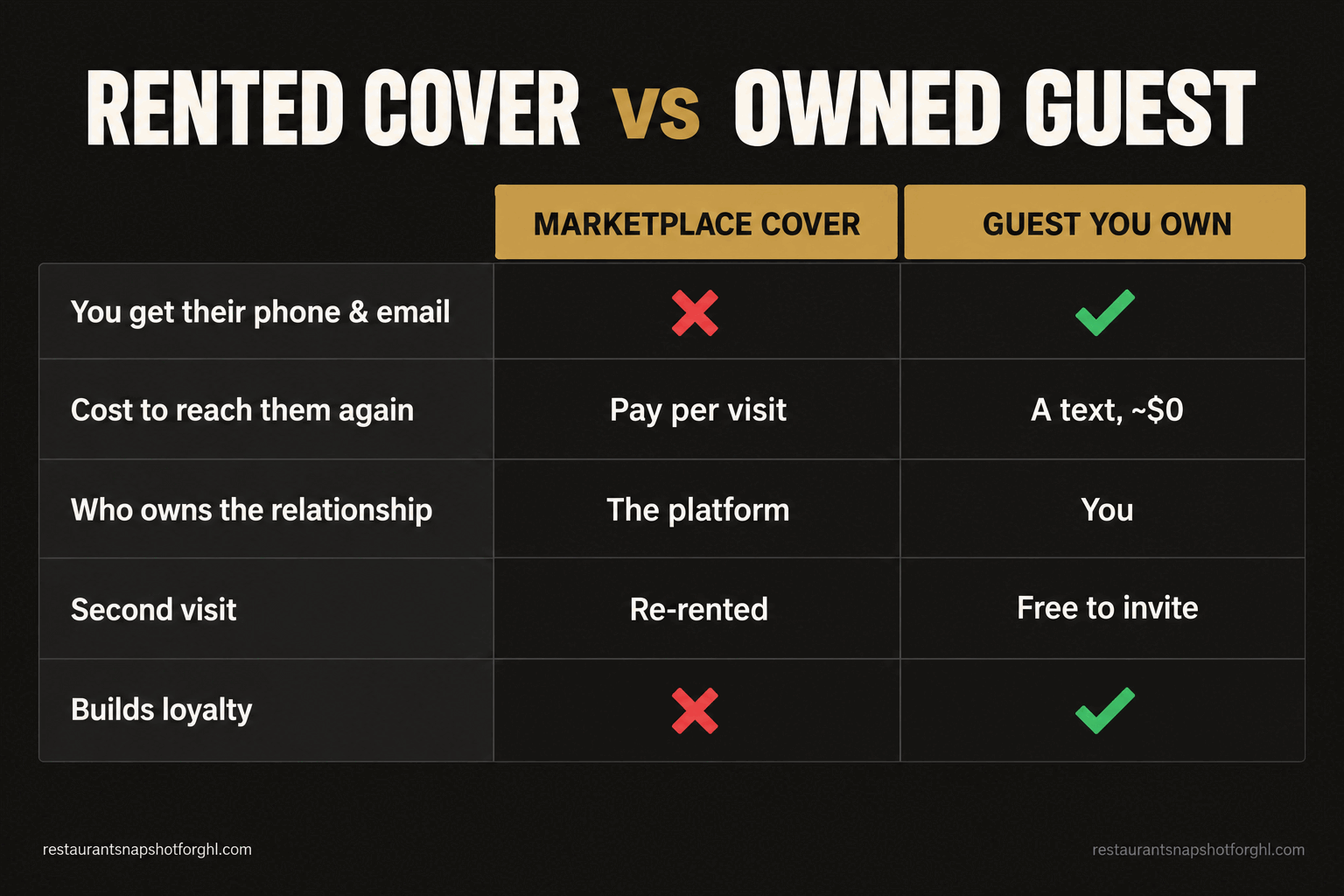
Here is the short version. Every marketplace cover costs you the visible fee plus three invisible costs: you do not own the guest, you re-rent that same guest every visit, and the arrangement trains diners to pick you on price instead of loyalty. The fee is the cheapest part.
Table of Contents
- What a “marketplace cover” actually is
- The visible bill: what each marketplace charges
- The invisible bill: three costs that never hit the invoice
- Run the math on one cover
- Three restaurants, three different marketplace bills
- Steal this: the per-cover worksheet and the capture line
- The compliance line you cannot skip
- Objections, answered straight
- FAQ
What a “Marketplace Cover” Actually Is
A marketplace cover is any guest who reaches your table through a platform that stands between you and the diner. You did not get the booking. The platform did, and handed it to you for a fee. There are four of these in most restaurants, and most operators only count one.
The reservation network (OpenTable, Resy, Tock, SevenRooms): a diner opens the app, sees twelve restaurants, and picks yours. Third-party delivery (DoorDash, Uber Eats, Grubhub): the order never touches your dining room, but it is still a cover you served. Discovery and listings (Google, Yelp, the map pack, paid placement): deciding whether a stranger searching “dinner near me” even sees you. And the review gatekeepers, the same Google and Yelp, deciding whether that stranger trusts you enough to walk in.
Each one is useful, and a new restaurant with no list and no reputation needs them. The problem is that most operators treat the monthly invoice as the whole price, when it is the smallest part of what the arrangement costs.
The Visible Bill: What Each Marketplace Charges
Reservation networks split into two camps. OpenTable charges a monthly base plus a fee for every seated diner it sends you. In 2026 that is $149 a month on Basic with $1.50 per network cover, scaling to $299 (Core) and $499 (Pro) with a $1.00 per-cover fee (OpenTable). In January 2026 OpenTable also added a 2 percent transaction fee on prepaid reservations, deposits, and no-show charges (Eat App, 2026). Resy and Tock, both now owned by American Express, run the other model: a flat monthly fee and no per-cover charge. Resy is $289 a month for Platform and $459 for Platform 360 (Resy), and Tock runs flat tiers with a small percentage only on prepaid bookings (Tock). We break the four down side by side in what a reservation system really costs in 2026.
The per-cover model scales against you: book a thousand network covers a month on the Pro plan and the per-cover line alone is $1,000 on top of the $499 base.
Per-seated-cover fee by reservation platform, 2026. Resy and Tock use a flat monthly fee with no per-cover toll. Source: OpenTable, Resy, Tock.
Third-party delivery is the heavier bill by a mile. DoorDash runs tiered commissions of 15, 25, and 30 percent per order, Uber Eats sits in the 20 to 30 percent range, and Grubhub stacks a marketing commission on a delivery fee near 10 percent (Rezku, 2026). With processing, placement, and promos added, the real take reaches 30 to 40 percent (Get Sauce, 2026). On a 3-to-5-percent net margin, a 30 percent commission does not trim the order, it erases the profit. We run the full delivery math in what the delivery apps really cost.
What a single $40 delivery order gives away at each commission level, in dollars. The “all-in” bar adds processing, placement, and promo costs. Source: Rezku, 2026.
Discovery and ads are an auction: you bid for the map pack and the sponsored slot, and the cost floats with how many competitors are bidding tonight. What stays true is that most diners vet a restaurant through Google and reviews before they call (Toast, 2026), so you can rent that slot forever or earn it with our local SEO playbook.
Here is the summary. Watch the last column.
| Marketplace | What you pay | Fee model | Keeps your guest data? |
|---|---|---|---|
| OpenTable | $149-$499/mo + $1.00-$1.50 per cover | Base + per cover | Largely yes |
| Resy / Tock | $289-$459/mo flat, no per-cover fee | Flat monthly | Largely yes |
| DoorDash / Uber Eats / Grubhub | 15-30% commission, 30-40% all-in | Per order | Yes, almost entirely |
| Google / Yelp ads | Variable auction bid | Per click or placement | Yes |
The Invisible Bill: Three Costs That Never Hit the Invoice
The fee is what the marketplace charges you. The costs below are what it keeps, and they are worse because they compound and no invoice names them.
Cost one: you do not own the guest. When a diner books through OpenTable or orders through DoorDash, the platform owns the phone number, the email, the visit history, and the permission to message. You served the food. They kept the customer. This is the cost that matters most, because the guest list is the single asset that fills a slow Tuesday for free, and here it never lands in your hands.
How it quietly costs you: a guest has a great night, you would love to invite them to your next wine dinner, and you have no way to reach them. The platform does, and it will rent that access back to you.
Cost two: you re-rent the same guest on every visit. Because you never captured the relationship, every future visit is a new acquisition you pay for again, a toll paid twice on a guest you already earned. Owned guests do not work like this: once a diner is on your list, the next ten visits cost you a text. A new customer costs 5 to 25 times more than keeping one (Harvard Business Review, 2014), and repeat guests already drive around 60 percent of restaurant revenue (Olo). Paying marketplace rates to re-acquire your own regulars is paying new-customer prices for repeat business.
How it quietly costs you: your Thursday four-top books every visit through OpenTable out of habit, so you pay $6 a visit forever for a guest who would gladly text you direct.
Cost three: it trains diners to shop you on price and convenience. A marketplace is a shelf of competitors: the diner is comparing you to eleven other restaurants on photos, star rating, and whether there is a deal, and delivery apps make it worse by putting your food next to a “20 percent off” banner from the place down the block. Over time the platform teaches your own guests that the relationship is transactional, so loyalty erodes into whoever is cheapest or closest tonight. Our piece on restaurant customer lifetime value shows what that eroded loyalty is worth over a year.
How it quietly costs you: a diner who would have become a monthly regular stays a comparison shopper, picks the competitor with the promo next month, and you never find out why.
Run the Math on One Cover
Follow one real guest, because the per-visit numbers hide the yearly truth.
A party of four comes in at about $45 a head, a $180 check before tip. Booked through OpenTable Basic, the cover fee is 4 covers times $1.50, so $6. On that one night that feels like nothing. The trouble is what did not happen: you got no phone numbers, no emails, no permission to invite them back. So when you want them for your Tuesday tasting next month, you cannot reach them, and they rebook the same way, another $6, or they never come back.
Now say that same four-top orders in instead, a $120 delivery order through DoorDash on the 30 percent Premier tier. That is $36 gone, before packaging and the card fee, and again you got no guest data. The same party ordering delivery twice a month at $36 a shot is $864 a year handed to the app, for guests who live three miles away and already love your food.
The owned-channel version looks different. You capture the party once with a table-tent QR code and a consent line. Every invitation after that, the tasting, the birthday, the slow-night text, costs a fraction of a cent. Same guests, same food, a tiny fraction of the toll.
Three Restaurants, Three Different Marketplace Bills
The leak is the same shape everywhere, but the size and the first move depend on where you sit.
The solo spot (one location, owner runs everything). Your bill is probably one reservation platform plus whatever delivery you allow, and the monthly number feels manageable. The hidden cost hurts you most, because you have the least time to spare. Start with capture, not cancellation: keep the platforms that bring real new diners, but put a QR code on every table and a consent line on every receipt so a marketplace cover becomes an owned guest on the second visit. You do not have to quit OpenTable to stop paying it forever, you just have to stop letting it keep the relationship.
The growing group (two or three locations, a part-time marketer). Your bill is bigger and messier, and the trap is that each location hoards its own guests. A diner known at one venue is a stranger at the other, so you re-acquire guests you already have across the street. One shared list across venues is the asset. Capture everywhere, tag by home location, and the first win-back campaign usually pays for the whole system. See the 60-day win-back playbook.
The established operator (four or more locations). You are running a program, not a promotion, and at your volume the per-cover and commission lines are five and six figures a year. The discipline is measurement: know your blended cost per marketplace cover, know what an owned cover costs, and move demand from the first toward the second. Operators are automating this: in 2026, 26 percent use AI-related tools, and marketing is the top use, with 19 percent of full-service operators using it for exactly this kind of outreach (Restaurant Dive, 2026).
Steal This: The Per-Cover Worksheet and the Capture Line
Two things to take with you. First, the worksheet to find your own blended cost per marketplace cover. Run it once.
Second, the capture line that turns a marketplace cover into an owned guest. The whole fix starts here, at the table, with consent. Put it on the table tent, the Wi-Fi splash, the receipt-by-text, and the order confirmation.
That one line, at every touchpoint, is how you stop re-renting diners. The segmenting and win-backs that follow live in our restaurant SMS marketing playbook, run by CRM and workflow automations and SMS automation.
The Compliance Line You Cannot Skip
Owning a guest list is the whole point, and the moment you text that list you are regulated. The TCPA requires clear prior consent before any marketing text and an easy opt-out in every message (FCC). A2P 10DLC is the carrier registration that lets your business number send these texts at all, and skip it and carriers filter you before a guest sees the message. The violation restaurants commit most is harmless-looking: a host collects a number “for the reservation” and the restaurant later texts a promo to it, but that consent does not cover marketing. Capture with the language above, register your number, keep a record of each opt-in, and honor STOP instantly. This is not legal advice, so read the full breakdown in our TCPA and A2P 10DLC guide and talk to your own counsel.
Objections, Answered Straight
“The marketplaces bring me new diners I would never reach.” True, so keep them for discovery. The mistake is letting a platform stay the owner of a guest it only introduced. Use the marketplace to meet a stranger, then capture that stranger into a list you own so the next twenty visits are yours. Discovery is worth paying for once, not forever.
“I do not have time to build and manage a guest list.” The capture is a QR code and a consent line, which takes a server no extra time. Everything after that, the tagging, the birthday club, the win-backs, runs on automations you set up once. A list you tend by hand is one you will forget, which is the real reason to have it done for you.
“Aren’t these fees just the cost of doing business?” The visible fee, maybe. The invisible cost is a choice. Paying $6 to book a four-top is fine. Paying to re-acquire that same four-top every visit for a year, because you never captured them, is the cost of letting someone else do the one part of the business that compounds.
“I already have a POS. Isn’t that my guest data?” Partly. A POS often has names and card tokens, but not consented marketing permission, not a list you can legally text, and rarely the automation to act on it. The asset is not raw data in a system, it is a consented, reachable, segmented list plus the engine that messages it, which is what our guest-list playbook walks through.
Frequently Asked Questions
The real cost of marketplace covers: quick answers
What does it actually cost to book a cover through OpenTable?
On OpenTable's Basic tier in 2026 it is $149 a month plus $1.50 per network cover, scaling to the $299 and $499 tiers with a $1.00 per-cover fee, plus a 2 percent transaction fee added in January 2026 on prepaid bookings and deposits. The bigger cost is that OpenTable largely keeps the guest relationship. See our reservation cost comparison.
Why is a delivery order so much more expensive than a reservation cover?
Reservation networks charge a small flat or per-cover fee. Delivery apps take a percentage of the whole order: 15 to 30 percent, and 30 to 40 percent all-in with processing and promos. On a 3 to 5 percent net margin that can erase the profit on the order. Our delivery cost breakdown runs the numbers.
What is the hidden cost people miss with third-party platforms?
The platform keeps the guest's contact details and permission to message, so you cannot invite that diner back for free. You re-rent the same guest on every visit, which hurts when repeat guests drive about 60 percent of revenue and a new one costs 5 to 25 times more than keeping one.
Do I have to quit OpenTable and the delivery apps to fix this?
No. Keep them for meeting new diners. The fix is to capture every marketplace cover into a list you own, with consent, so the second visit onward is a guest you reach directly instead of a cover you pay to re-acquire. Discovery is worth paying for once, not forever.
How do I legally text guests I collect?
Get prior written consent before the first marketing text, register your number for A2P 10DLC so carriers deliver your messages, put a one-word opt-out like STOP in every message, and keep a record of each opt-in. A number collected for a reservation does not count. Read our TCPA and A2P 10DLC guide.
The Bottom Line
Back to that Monday morning and the deposit that felt lighter than the weekend looked. The room really was full. The gap is that too many of those covers came through someone else’s marketplace, which took its fee and, worse, kept the guest, so you pay for the same diners again next month. The fee was never the real cost. Owning nothing was.
You do not have to burn the platforms down. Use them to meet strangers, then capture every stranger into a list you own, text them with consent, and let the birthday club and win-backs carry the repeat business for the price of a message. Do that, and the full weekend finally shows up in the deposit.