
It is 3:10pm on a slow Tuesday. You have 820 phone numbers collected at the host stand over two years, and a bar that will be dead by 5. The fix looks obvious: text everyone “2-for-1 margaritas, 4 to 6 today only,” and watch a dozen regulars wander in. Your thumb is over send.
Stop for two minutes. That one text can trigger two separate bodies of law at once. One decides whether you were allowed to text those 820 people; the other decides whether you were allowed to say that about a drink in your state. Get either wrong and the Tuesday you tried to save becomes the most expensive shift of your year.
A quick, honest disclaimer: this is a practical operator’s guide, not legal advice. Alcohol rules change state by state and the TCPA shifts with court rulings, so use this as a starting checklist, then confirm specifics with your state’s Alcoholic Beverage Control (ABC) board and a TCPA attorney.
Table of Contents
- The 30-second answer
- What getting it wrong actually costs
- Law one: TCPA and A2P 10DLC, the federal layer
- Law two: your state decides what you can say about a drink
- Steal this: the copy that keeps you legal
- Three scenarios: solo bar, two-state group, ban-state operator
- Objections, answered straight
- Frequently asked questions
The 30-Second Answer
Yes, you can legally text a happy hour deal, but only if you clear two gates first. Gate one is federal: the people you text must have given prior express written consent to marketing texts, and your sending number must be registered under A2P 10DLC. Gate two is local: the drink promotion has to be legal to run, and legal to advertise, in the state where the restaurant sits. Most operators clear neither, because numbers scribbled on a reservation sheet are not marketing consent, and in seven states “half-price drinks, 4 to 6” is not a promotion you may run.
Think of it as who and what. The TCPA (one official, at the FCC) cares only whether this person agreed, in writing, to get marketing texts: it governs who is on your list. Your state liquor board cares whether the offer is legal to run and to advertise: it governs what you may say about a drink. Most advice covers only the first, which is how a careful operator with clean consent still advertises an offer the state bans. Clear both gates once and the blast becomes one of the fastest ways to fill a dead weeknight without touching your Saturday pricing.
What Getting It Wrong Actually Costs
The TCPA sets statutory damages at $500 per text, rising to $1,500 per text if a court finds the violation willful or knowing, and each message is a separate violation (FCC). That is why these class actions are brutal for small senders: the penalty is attached to the send, not the sale.
Run it against that spreadsheet of 820 numbers: if none gave written consent, one blast is 820 violations, or $410,000 of theoretical exposure at the statutory minimum. No plaintiff collects the full figure from a corner bistro, but it is what funds the lawsuit.
That exposure matters here because the cushion is thin: the National Restaurant Association projects $1.55 trillion in 2026 industry sales, yet 45% of operators were not profitable in 2025 (NRA, 2026). A compliance mistake lands on a business already fighting for a profitable year.
Theoretical TCPA exposure from one non-consented blast, at the $500 statutory minimum per text (list size x $500); willful violations reach $1,500 per text. Maximum statutory exposure, not a typical settlement. Source: FCC, TCPA.
On the state side, dollar penalties are usually smaller but hit where it hurts most: your liquor license, through a warning, then fines, then suspension. And a text blast is far more durable, and far more screenshotted, than a chalk sign on the door.
Law One: TCPA and A2P 10DLC, the Federal Layer
This is the half you can fully control, so get it airtight.
Written consent is the whole ballgame
For marketing texts, the TCPA requires prior express written consent: the guest affirmatively agreed, in writing, to receive promotional messages from your restaurant, with the key terms disclosed where they agree. A pre-checked box does not count. A number captured for a reservation does not count either, because that was transactional consent.
Where it breaks: the most common failure is treating one list as two. Guests give a number for a booking, you later blast them a promo, and you have crossed from transactional to marketing without new consent. Keep the two streams separate, tag every contact with how and when they opted in, and never let a transactional-only number into a marketing send. (One 2025 note: the FCC’s “one-to-one consent” rule was vacated by the Eleventh Circuit before it took effect, which did not loosen your duty to get clear written consent (Nat Law Review, 2025).)
A2P 10DLC: you can’t even send until you register
Even with perfect consent, there is a step before the first text. Since February 1, 2025, major US carriers block all application-to-person SMS from unregistered 10-digit numbers. You register your brand (legal name, EIN, address, website) and your campaign (reservations, waitlist, promotions) with The Campaign Registry, almost always through your messaging provider (getterms; Flyght). A trust score governs throughput; budget a few days to a few weeks.
Where it breaks: operators skip this because texts seem to send fine from a personal cell, right up until a carrier filters them silently and your blast reaches a third of the list with no error you can see. Register before you rely on SMS, and label the campaign honestly: tagging marketing as transactional is what sinks a trust score.
The STOP rules got stricter in 2025
Honoring opt-outs is not optional, and the bar moved up. Effective April 11, 2025, the FCC’s consent-revocation rule lets a guest revoke “in any reasonable manner,” and words like stop, quit, cancel, unsubscribe, and revoke are automatic opt-outs you cannot argue with. You then have 10 business days to process it, down from the old 30-day window, and may send exactly one confirmation text (Nat Law Review, 2025; Brownstein, 2024).
Where it breaks: a guest replies “stop” to your promo and your system keeps them in the loyalty program because that is a “different list.” Treat a STOP broadly unless you clearly run separate, knowingly joined programs, and make sure your platform processes it automatically.
Law Two: Your State Decides What You Can Say About a Drink
Now the half most guides ignore: even with flawless consent, the content has to be legal where you operate, and alcohol promotion is regulated state by state.
The seven states where happy hour itself is banned
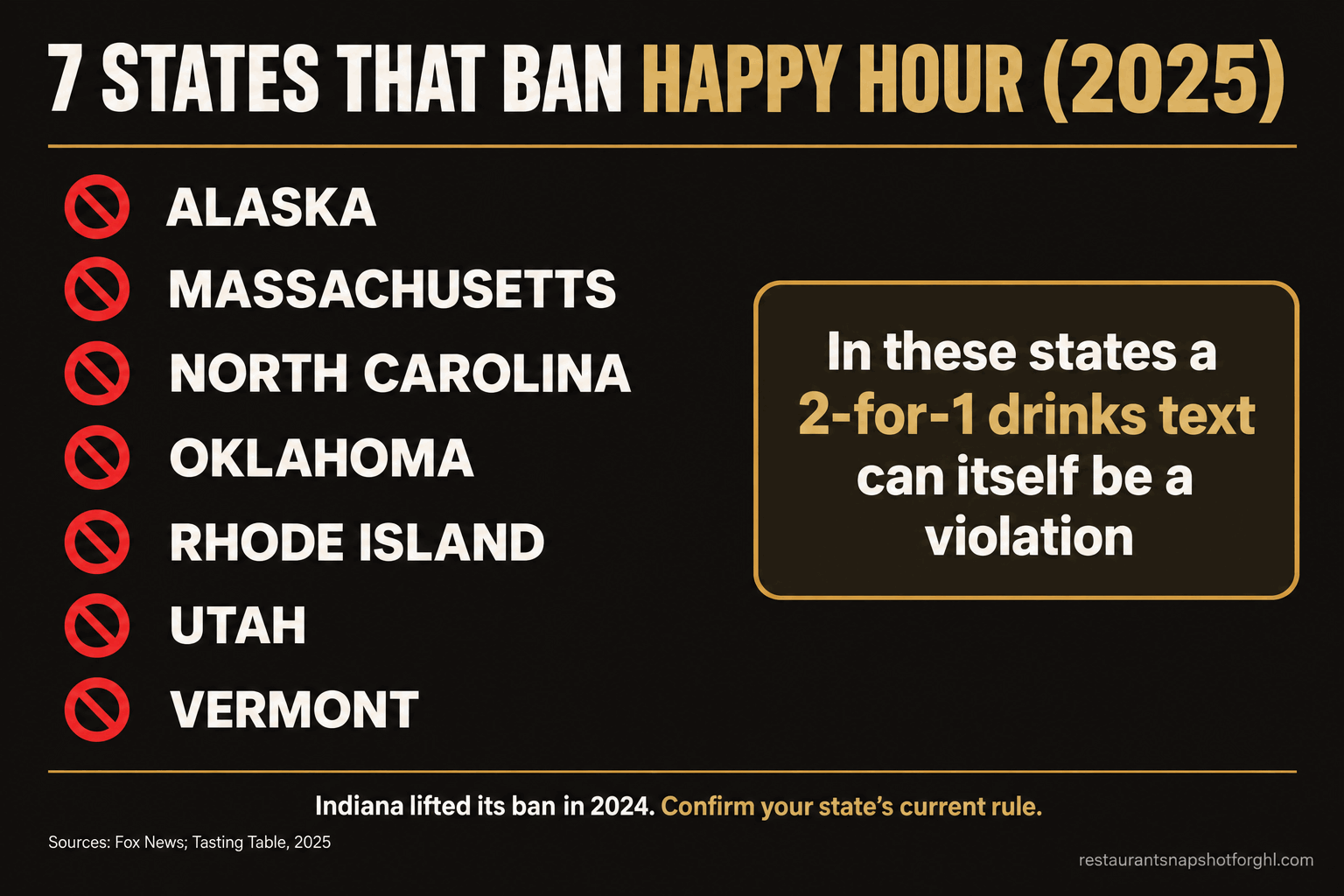
As of 2025, seven states ban discounted, time-limited drink specials outright: Alaska, Massachusetts, North Carolina, Oklahoma, Rhode Island, Utah, and Vermont (Fox News, 2025; Tasting Table, 2025). There, “2-for-1 drinks, 4 to 6” is not a promotion you may run, so texting it advertises an offer your state prohibits.
The map is not frozen. Indiana lifted its ban effective July 1, 2024, and Illinois repealed a roughly 25-year ban in 2015 (Tasting Table, 2025). Because the list shifts, confirm your own state’s current rule before you send.
The trap: legal to pour, illegal to advertise
Even where a discount is legal to run, many states separately restrict how you may advertise drink prices, especially off-premises. Your text leaves the building, so it is off-premises advertising, and the question is not only “can I run this special” but “can I advertise it in a text.”
Where happy hour is legal in your state, keep it simple: name the offer, the time, and the location, and skip anything that encourages overconsumption. Where it is banned, do not put a drink discount in the text at all; fill the room with the food, the music, or a meal bundle instead, using the levers in our guide to filling slow weeknights without discounting.
Massachusetts, in detail
Massachusetts is the cleanest example of why “who” and “what” are different questions. Under 204 CMR 4.03, a licensee may not give away free drinks, serve more than two drinks to one person at a time, sell drinks below the price normally charged that week, or sell unlimited drinks for a fixed price. Crucially, subsection (2) also bars advertising or promoting any of those practices, on or off the premises (Mass.gov, 204 CMR 4.03; Justia).
So a Boston restaurant with perfect TCPA consent still cannot legally text “half-price cocktails tonight”: the messaging law is satisfied, the alcohol law is not. What 204 CMR 4.04 does allow is free food or entertainment, drinks sold as part of a meal, or wine by the bottle or carafe with a meal, so the compliant Massachusetts text is about the meal and the room, not the drink price.
Steal This: The Copy That Keeps You Legal
Templates to lift; which promo version is legal depends on your state.
The opt-in line (host stand, QR code, or online booking). Put this next to the box where the guest agrees:
Join [Restaurant] texts for specials and events. By checking this box you agree to recurring marketing texts from [Restaurant] at the number provided, sent by autodialer; consent is not a condition of purchase. Msg frequency varies, msg & data rates may apply. Reply STOP to cancel, HELP for help. [Terms & Privacy.]
The happy hour promo, open-state version (use only where timed drink specials are legal to run and advertise):
[Restaurant]: Slow-afternoon fix. Happy hour today 4 to 6pm, $2 off all draft beer and house wine, plus half-price wings. Walk in or reply TABLE to hold one. Reply STOP to opt out.
The happy hour promo, ban-state version (use where drink discounts cannot be advertised; it fills the room without naming a discount):
[Restaurant]: Quiet Tuesday = your night. Live acoustic set 6 to 8pm, full menu running, and a $25 three-course early prix fixe. Reply TABLE to grab one. Reply STOP to opt out.
The STOP confirmation (the one follow-up you are allowed to send):
[Restaurant]: You’re unsubscribed and won’t get more marketing texts. Sorry to see you go. Reply START to rejoin anytime.
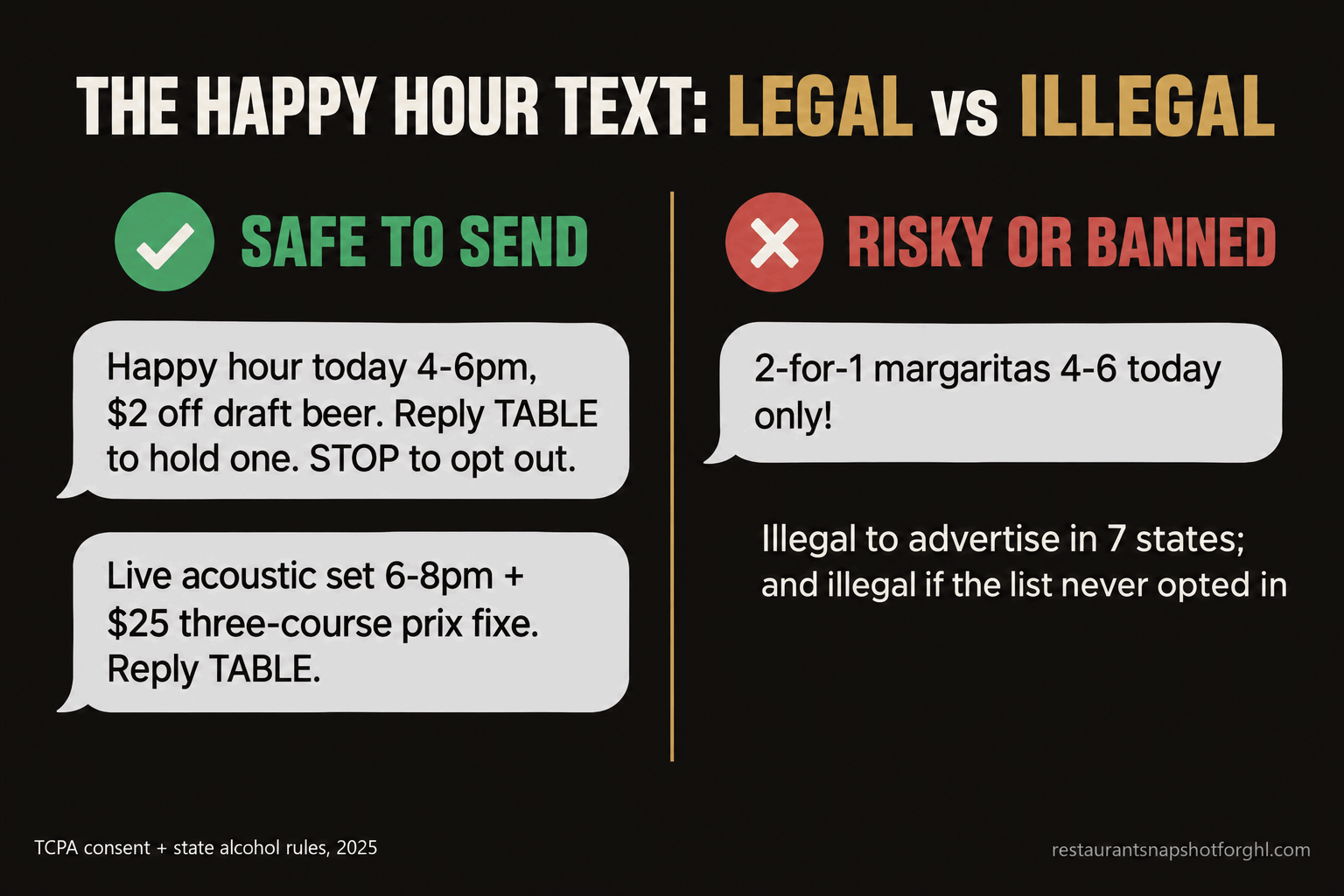
Where it breaks: operators copy the open-state promo into a ban-state blast. Do not. The drink-discount line is the exact phrase an ABC inspector screenshots. When in doubt, use the ban-state version everywhere; it is legal in all 50 states and still fills the table. And log every opt-in with a timestamp and source, because in a dispute the burden is on you to prove consent. For the deeper mechanics, our TCPA and A2P 10DLC guide is this post’s companion, and the broader playbook lives in restaurant SMS marketing.
Three Scenarios: Solo Bar, Two-State Group, Ban-State Operator
The right move changes with your footprint.
Scenario 1: the solo bar in an open state. One room in Texas, a 900-number host-stand list. Your only real risk is the federal layer, because the special is legal to run and advertise. Launch a clean opt-in at the host stand and booking page, rebuild the list with timestamped consent, and register A2P 10DLC. The honest read: the old scraped list is not usable for marketing, so re-permission it rather than blasting it cold.
Scenario 2: the two-location group straddling a state line. One room in an open state, one across the border in a ban state. Write one text for both lists and you get burned: the offer legal at location A may be illegal to advertise at location B. Segment by location and gate the drink-discount language to the open-state segment only.
Scenario 3: the ban-state operator. A restaurant in Massachusetts, Utah, or another of the seven. Your TCPA house can be perfect and you still cannot text a drink discount, full stop. Your SMS pivots to what the state allows: food specials, events, meal-bundled wine, and a reminder that you are open. The honest read: this is not the handicap it feels like. Restaurants win slow nights with a reason to come in, not the cheapest drink, which is why we push operators to own their guest list rather than rent it.
Objections, Answered Straight
“My POS already texts my customers, so I’m covered, right?” Not necessarily. POS and reservation tools often send transactional texts under transactional consent, so the second you push a promo through that same pipe you may be marketing to people who only agreed to booking confirmations. Check whether your POS collected marketing consent and registered an A2P 10DLC marketing campaign. Many have not.
“Nobody sues a small restaurant over a text.” TCPA litigation is a cottage industry because damages are per-text and need no proof of harm. Firms run lists looking for unconsented blasts, and the defendant’s size matters less than the clean math of 800 texts times $500. You do not have to be a chain to be a target.
“I collected these numbers at the host stand, isn’t that consent?” The most common and most expensive misunderstanding. A number given to confirm a reservation is consent for that, not for marketing, and using it for a promo is the textbook violation. The fix: ask for marketing consent with the disclosure language above, and keep the two lists separate forever.
“Can’t I just use email instead?” Email’s rules (CAN-SPAM) are far lighter, so run email for longer promos and SMS for the time-sensitive nudge. But the alcohol-advertising rules follow the message, not the channel: a drink discount banned in a text is banned in an email too.
Frequently Asked Questions
Is it legal to text customers a happy hour or drink special?
It can be, if you clear two requirements. First, the TCPA: every recipient must have given prior express written consent to marketing texts, and your number must be registered under A2P 10DLC. Second, your state's alcohol rules: the promotion must be legal to run and to advertise where you operate. In the seven states that ban happy hour, you cannot advertise a timed drink discount at all, even with perfect consent.
Which states ban happy hour in 2025?
Seven: Alaska, Massachusetts, North Carolina, Oklahoma, Rhode Island, Utah, and Vermont. The list changes; Indiana lifted its ban July 1, 2024, and Illinois repealed its ban in 2015. Confirm your state's current status with its Alcoholic Beverage Control board before advertising any drink promotion.
Is a host-stand phone number enough consent to text a promo?
No. A number given to confirm a reservation is transactional consent, not marketing consent, and the TCPA requires prior express written consent specifically for marketing. Texting a promo to a host-stand or Wi-Fi list that only agreed to transactional messages is the most common TCPA violation restaurants make, at $500 to $1,500 per text.
What do I have to do when someone texts STOP?
Honor it. Under the FCC's 2025 rule, words like stop, quit, cancel, unsubscribe, and revoke are automatic opt-outs, and you have 10 business days to process the request, down from 30. You may send one confirmation text, and should treat an opt-out broadly unless you clearly run separate, knowingly joined programs.
Can I text a drink discount if my restaurant is in Massachusetts?
No. Under 204 CMR 4.03, Massachusetts bans discounting drinks and bars advertising those practices on or off the premises, so a text pushing half-price or two-for-one drinks violates the rule even with perfect TCPA consent. You can promote food specials, entertainment, drinks sold as part of a meal, or wine by the bottle or carafe with a meal instead.
The One Line That Changes the Math
Back to 3:10pm on that slow Tuesday, thumb over send. The difference between the blast that fills the room and the one that funds a lawsuit is two questions you answer in advance: is this list consented and my number registered, and is this offer legal to say in my state. The asset was never the discount; it is the list and the consent behind it that let one text pull regulars off their couches on a dead night. Build that correctly and the happy hour text is one of the cheapest tools you own; skip either gate and it is the most expensive message you ever send.
Related Reading
- TCPA & A2P 10DLC: what restaurants need to know before sending one SMS
- Restaurant SMS marketing: the complete 2026 playbook
- How to fill slow weeknights without discounting your Saturday
- How to own your restaurant’s guest list instead of renting it
- GoHighLevel for restaurants: the complete 2026 guide
- Get the done-for-you system installed in 24 hours
Sources
- TCPA statutory damages and framework: FCC, Telephone Consumer Protection Act
- One-to-one consent rule vacated (Jan 2025): National Law Review, 2025
- Consent-revocation rule, effective April 11, 2025: National Law Review, 2025; Brownstein, 2024
- A2P 10DLC registration: getterms; Flyght, 10DLC for restaurants
- States banning happy hour: Fox News, 2025; Tasting Table, 2025
- Massachusetts 204 CMR 4.03: Mass.gov PDF; Justia; Mondaq, 2019
- Industry context: NRA 2026 State of the Restaurant Industry