
Walk into the back office of a busy Atlanta restaurant — a Westside taproom, a Buford Highway family spot, a Beltline brunch place — and you’ll find the same thing taped together behind the host stand: a POS that holds the sales, a reservation app that holds the covers, a spreadsheet of regulars, a mailer tool nobody’s logged into since spring, a review dashboard, a social scheduler, and a phone that keeps ringing through the dinner rush. Each one works. None of them talk to each other. And in the gaps between them, covers leak out one guest at a time.
That gap has a name — a disconnected tech stack — and for an independent operator it’s one of the most expensive problems on the P&L precisely because it never shows up on the P&L. This is the honest accounting: what a fragmented stack actually costs an Atlanta restaurant, why it hurts more here than almost anywhere, and how operators are consolidating six-to-ten tools into one system that finally works as a single machine.
Table of Contents
- The 30-second answer
- What a disconnected restaurant tech stack actually looks like
- The tech paradox: operators believe in it, but it isn’t paying off
- Why Atlanta can’t afford a duct-taped stack
- The five hidden costs of a disconnected stack
- What “connected” looks like: one system instead of eight
- How consolidation actually works (without losing your data)
- Frequently asked questions
The 30-Second Answer
A disconnected restaurant tech stack costs you money in ways you never invoice for: guest data trapped in silos, staff re-keying the same information by hand, subscriptions you barely use, follow-up that happens late or never, and repeat covers you already earned but let slip away. None of it appears as a line item, which is exactly why it goes unfixed for years.
The reason it persists is that each individual tool is fine. Your POS is fine. Your reservation app is fine. The problem is the space between them — because that’s where your guest lives. A diner books on one platform, pays on another, and should get a review request and a win-back text from a third, except those systems never share the record. The fix isn’t a better POS or a slicker reservation app. It’s a connective layer — one system that pulls every tool into a single guest view and automates the follow-up. That’s what the rest of this piece is about.
What a Disconnected Restaurant Tech Stack Actually Looks Like
Ask an owner “how many software tools do you pay for?” and the honest answer is usually “more than I can name off the top of my head.” A typical independent Atlanta restaurant is quietly running some version of this:
- A POS (Toast, Square, or Clover) that holds every ticket, item, and dollar of sales.
- A reservation platform (OpenTable, Resy, or SevenRooms) that holds covers, cancellations, and no-shows.
- A third-party delivery channel or two (DoorDash, Uber Eats) that holds the names and habits of guests you’ll never see again — because that data stays on their platform, not yours.
- An email or SMS tool for the occasional blast, usually under-used.
- A review dashboard for Google and Yelp, checked when someone remembers.
- A social scheduler for Instagram and Facebook.
- A spreadsheet (or three) for regulars, gift cards, and private events.
Seven or eight systems, each holding a slice of the same guest. That’s not a strategy — it’s what happens when you solve one problem at a time over five years. And it matches the data: 69% of restaurants were already running multiple disconnected technologies by 2019 (Restaurant Dive, 2019), and the appetite to fix it has only grown — 85% of operators now rank integration between systems as a top priority for their POS (Hospitality Technology, 2024). Operators aren’t asking for more features. They’re asking for the features they have to finally connect.
The Tech Paradox: Operators Believe In It, But It Isn’t Paying Off
Here’s the tension at the heart of the problem. Restaurants have bought the tech gospel — and they’re right to. But the payoff is stuck.
In the National Restaurant Association’s 2025 State of the Restaurant Industry, 83% of operators said technology gives them a competitive advantage and 69% said automation has improved productivity. Yet when asked whether those same technology investments had actually improved profitability, only 28% said yes (National Restaurant Association / Nation’s Restaurant News, 2025). That’s a 55-point gap between belief and bottom-line result.
Why the gap? Because tools you can’t connect don’t compound. Eight systems each doing their own job in isolation give you eight bills and eight logins, but they don’t give you the one thing that actually moves profit: the automatic follow-up that turns a first visit into a fourth. The advantage is real — you can see it — but it stays locked behind the walls between your apps.
Why Atlanta Can’t Afford a Duct-Taped Stack
Every city is competitive. Atlanta is a specific kind of hard. Foodservice is the third-largest private employer in Georgia, with roughly 18,900 eating-and-drinking places doing about $24.9 billion in annual sales (National Restaurant Association, 2024). And the vast majority of those are exactly the operators who can least afford leaks — 93% of Georgia’s food-and-beverage businesses have fewer than 50 employees (UGA Cooperative Extension, 2025).
The competition doesn’t let up, either. More than 200 new restaurants, food halls, breweries, and bakeries opened across metro Atlanta in 2024 (AJC, 2024), and the city now carries genuine culinary weight — eight Michelin-starred restaurants among them (Discover Atlanta, 2025). More rooms chasing the same diners means the guest you don’t answer, don’t remember, or don’t re-invite simply goes to one of the hundreds of alternatives a tap away.
Now layer on the margins. Full-service restaurants net just 3–5% (Toast, 2026). On a 4% margin, a dollar saved or a repeat cover recovered is worth many times a dollar of new top-line revenue you had to fight and spend to win. A disconnected stack quietly bleeds both — and in Atlanta, there’s always someone down the block ready to catch what you drop.
The Five Hidden Costs of a Disconnected Stack
None of these show up as an invoice. All of them show up in your bank balance.
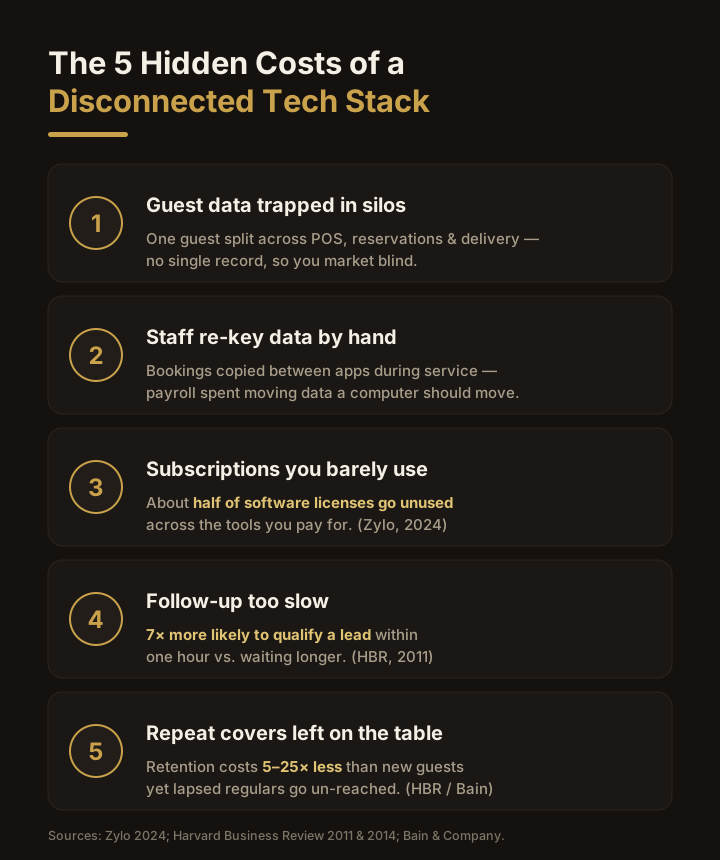
1. Guest data trapped in silos
Your best asset is your guest list, and a fragmented stack shreds it. The couple who booked on Resy, paid on Toast, and ordered delivery on DoorDash exists as three unlinked records in three systems that never merge — and the delivery guest isn’t even yours, because the platform keeps the name, email, and phone number, not you (SevenRooms). Without one unified guest view, you can’t see who your regulars are, who’s lapsed, or who’s worth a VIP touch. You’re marketing blind.
2. Staff time lost to manual re-keying
When systems don’t sync, humans become the integration. A reservation gets copied off one screen into a spreadsheet, then typed into the email tool for a confirmation, then checked against the POS. Multiply that by every channel and every shift and you’ve turned a trained team member into a data-entry clerk — during service, when their attention is worth the most. That’s payroll spent moving information a computer should move for free.
3. Subscriptions you’re barely using
Sprawl is expensive even when you ignore it. Zylo’s 2024 SaaS Management Index found that companies actively use only about half of the software licenses they pay for, with a large share sitting idle within 30 days of purchase (Zylo, 2024). Restaurants are no different: the review tool nobody logs into, the second email platform, the scheduler you switched away from but never cancelled. Every one is a monthly charge against a 3–5% margin for a job another tool could already do.
4. Follow-up that happens late — or never
Speed is where the disconnected stack fails most expensively. When an inquiry lands in one silo and the person who’d respond is looking at another, the reply comes hours later, if at all. The classic Harvard Business Review study of 2,241 U.S. companies found that contacting a lead within an hour makes you about 7× more likely to have a meaningful conversation than waiting even 60 minutes longer — and 60× more likely than firms that wait 24 hours or more (Harvard Business Review, 2011). A diner deciding where to eat tonight won’t wait for tomorrow’s callback. Industry estimates put the price of unanswered restaurant phones alone at roughly $20 billion a year (QSR Magazine, 2023).
5. Repeat covers left on the table
This is the big one. The cheapest revenue in your restaurant is the guest who already loved it — and a siloed stack can’t reach them. Acquiring a new customer costs 5 to 25 times more than keeping one, and lifting retention by just 5% can raise profits 25–95% (Harvard Business Review / Bain & Company, 2014). Every regular who drifts because no birthday text, win-back offer, or review ask ever fired is retention profit you paid to earn and then quietly gave away. For the full math on this, see our guide to restaurant customer lifetime value.
What “Connected” Looks Like: One System Instead of Eight
The alternative isn’t buying a better version of each tool. It’s adding a connective layer that pulls them into one place — a single guest record, one inbox for every channel, and automated follow-up that runs whether or not anyone remembers to log in. Practically, that means using GoHighLevel as the hub and building the integrations that make your existing tools feed it: your POS, your reservation platform, your reviews, your social DMs, and your phone all writing to one guest view, in real time.
Here’s the difference, side by side.
Disconnected stack vs. one connected system
| Plan | Disconnected Stack | One Connected System recommended |
|---|---|---|
| Price | 8 logins, 8 bills | One hub (GoHighLevel) |
| Feature 1 | Guest split across POS, reservations & delivery — no single record | One guest view — every visit, spend & channel in one record |
| Feature 2 | Staff re-key bookings by hand during service | Bookings sync automatically; no manual re-keying |
| Feature 3 | Reviews, DMs & missed calls each live in a different app | Reviews, DMs, calls & forms land in a single inbox |
| Feature 4 | Follow-up depends on someone remembering | Confirmations, reminders, reviews & win-backs fire on their own |
| Feature 5 | Lapsed regulars go unnoticed until they're gone | Silent triggers re-engage lapsed guests automatically |
| Feature 6 | You pay for tools that overlap or sit unused | Consolidate overlapping tools into one bill |
| This is most restaurants | See how we build it → |
That “one connected system” isn’t a product you buy off a shelf — for most restaurants it’s a custom integration and migration project: connecting Toast, Square, or Clover to GoHighLevel; bridging OpenTable or Resy so covers trigger reminders and no-show recovery; wiring reviews and Instagram DMs into the same inbox; and, where you’re stuck on a legacy tool, moving your contacts and history into GHL without losing a thing. That’s exactly the work our GHL development team does — fixed-scope, built for your restaurant, not bolted on.
How Consolidation Actually Works (Without Losing Your Data)
The fear that keeps operators duct-taping is understandable: “Migrating sounds risky — what if I lose my guest list?” Done right, you don’t. A sane consolidation runs in four steps:
- Map the stack. List every tool, what data it holds, and where the guest record fractures. This alone usually surfaces two or three subscriptions you can cut on day one.
- Pick the hub and build the bridges. Stand up GoHighLevel as the single source of truth, then build the connectors that sync your POS, reservation platform, reviews, and social into it — two-way, in real time.
- Migrate what’s trapped. Move contacts, tags, visit history, and workflows out of legacy tools intact, then rebuild your automations better than they were. A clean migration is a data-transfer project, not a gamble.
- Automate the loop. With everything in one place, the capture → book → remind → review → win-back sequence finally runs on its own — the part a disconnected stack could never do.
You don’t have to do all of it at once. Many Atlanta operators start with the single most painful bridge — usually connecting the POS or reservation system to GHL, or ending the missed-call problem — and expand from there. If you’d rather have the whole guest-communication engine pre-built and simply installed, the done-for-you Restaurant Snapshot ships the full booking, reminder, review, and win-back system in about 24 hours; custom development is what connects your specific stack to it. Either way, the goal is the same: fewer tools, one guest view, and follow-up that never depends on you remembering.
Frequently Asked Questions
Restaurant tech stack & GHL integration — common questions
What is a 'disconnected tech stack' for a restaurant?
It's the normal situation where a restaurant runs several software tools that each hold part of the guest relationship but don't share data with each other — for example a POS (Toast, Square, Clover), a reservation platform (OpenTable, Resy, SevenRooms), a delivery app, an email or SMS tool, a review dashboard, and a social scheduler. Each works on its own, but because they don't sync, the same guest exists as separate, unlinked records, follow-up falls through the cracks, and you end up paying for overlapping tools. Surveys have found most restaurants run multiple disconnected systems, and integration between them is now a top operator priority.
Why does a disconnected stack cost me money if every tool works?
Because the value is in the connection, not the individual tool. When systems don't talk, your staff re-key data by hand, guest records fracture across apps, follow-up happens late or never, and lapsed regulars go unnoticed. The National Restaurant Association's 2025 report captures the tension: 83% of operators say technology is a competitive advantage, but only 28% say it has actually improved profitability. The gap is largely because unconnected tools don't compound into the automated follow-up that drives repeat visits.
Can you really connect Toast, Square, or Clover to GoHighLevel?
Yes. Custom connectors sync POS sales, loyalty check-ins, and spend thresholds into GoHighLevel as tagged, segmented guest records — in real time and, where the API allows, two-way. The same approach bridges reservation platforms like OpenTable and Resy so new covers and cancellations trigger reminders, no-show recovery, and post-visit review requests. The result is that your POS and booking tools finally feed the same guest view instead of living in silos. See the GHL development page for the full list of platforms we integrate.
Is migrating to one system risky — will I lose my guest data?
Not when it's handled as a proper data-transfer project rather than a rushed switch. A clean migration moves your contacts, tags, visit history, and workflows out of legacy tools into GoHighLevel intact, then rebuilds your automations. Nothing is deleted from the old system until the new one is verified. The bigger risk is staying on a fragmented stack that keeps leaking covers every shift.
Do I need the Restaurant Snapshot, custom development, or both?
It depends on where you're starting. The done-for-you Restaurant Snapshot installs the full booking, reminder, review, and win-back engine in about 24 hours and is the fastest path for most operators. Custom GHL development is what connects your specific existing tools — your POS, your reservation platform, a legacy CRM — to that engine, or builds features GHL doesn't ship out of the box. Many Atlanta restaurants use both: the snapshot for the core system, custom development for the integrations unique to their stack.
How much does a custom GHL integration or migration cost?
Custom builds are fixed-price by scope. Focused integrations typically start around $3K, with larger dashboards, AI chatbots, and reservation bridges running higher, and migrations quoted by data volume. There's also a pay-as-you-go hourly option. The fastest way to a real number for your restaurant is a free 30-minute discovery call, where the stack gets mapped and scoped.
Devon runs a small agency that builds and resells GoHighLevel systems to hospitality clients, from food trucks to fine dining. A former line cook turned funnel nerd, he’s obsessed with the unsexy plumbing of restaurant marketing: A2P 10DLC registration, two-way SMS, and POS + GHL integrations (Toast, Square, Clover) that finally make a restaurant’s tools talk to each other. His posts lean technical without losing the operator who has to live with the system.
Related reading
- GoHighLevel for restaurants: the complete 2026 guide
- Missed-call text-back for restaurants
- Online reservation system for restaurants: take direct bookings and cut per-cover fees
- Restaurant customer lifetime value: how to calculate it (and double it)
- Why Miami restaurants are hiring a GoHighLevel VA to run their marketing
Sources
- National Restaurant Association / Nation’s Restaurant News — 2025 State of the Industry: how much does technology really improve operations (83% advantage, 69% productivity, 28% profitability)
- Hospitality Technology — 2024 POS Software Trends Study (85% rank integration a top priority)
- Restaurant Dive — 69% of restaurants use multiple technologies but many want all-in-one (2019)
- National Restaurant Association — Georgia Economic Impact of the Foodservice & Restaurant Industry (~18,900 places, ~$24.9B, 3rd-largest private employer)
- UGA Cooperative Extension — Georgia Food & Beverage 2025 Outlook (93% under 50 employees)
- The Atlanta Journal-Constitution — 200+ metro Atlanta restaurants opened in 2024
- Discover Atlanta — James Beard & Michelin spotlight (8 Michelin-starred restaurants)
- Toast — Average Restaurant Profit Margin (3–5% full-service)
- Harvard Business Review — The Short Life of Online Sales Leads (2,241 companies; ~7× within an hour; 60× after 24h)
- Harvard Business Review — The Value of Keeping the Right Customers (acquisition 5–25× retention; +5% retention → 25–95% profit)
- Zylo — 2024 SaaS Management Index (about half of licenses unused)
- QSR Magazine — Restaurants are losing $20 billion to unanswered phone calls
- SevenRooms — Why guest data ownership matters for restaurants