
It is 4:30 on a Tuesday and you are walking the dining room before service. You count the book: six reservations, maybe eight walk-ins. Two nights from now the same room will be a two-hour wait, turning away the people you wish were here now.
So you do what everybody does. You post a half-price bottle night, a two-for-one that runs “Tuesday only.” The room fills. Then you run the numbers on Wednesday and realize you were busy and broke at the same time, and worse, half the tables were regulars who would have come anyway, now trained to wait for the deal.
Here is the short version, and then we build the whole thing. You do not fill a slow weeknight by making it cheaper. You fill it by moving demand you already have, and by reaching guests you already know, on a night they were not planning to come. No coupon required.
Table of Contents
- Why discounting backfires
- Move demand, do not cut price
- Stage 1: Find the slow night
- Stage 2: Build a list you own
- Stage 3: Segment the list
- Stage 4: A reason that is not a discount
- Stage 5: Channel, timing, and copy
- Stage 6: Birthday club and win-backs
- Three restaurants, three plans
- The compliance line
- Objections, answered
- FAQ
Why Discounting a Dead Tuesday Backfires
The short answer: stop trying to buy a crowd on your slow night and start moving the one you already have. A dead Tuesday is a demand problem, not a price problem, and discounts feel obvious because they work fast. The problem is what they cost and what they teach.
Start with the money. Full-service restaurants run net margins of about 3 to 5 percent (Toast, 2026). On a $1,000 night you keep thirty to fifty dollars. Run a 20-percent-off promotion to fill the room and you have not trimmed your margin, you have erased it, because the discount comes off the top line while food cost, labor, and rent do not move.
Then there is the lesson it teaches. Run “half-price bottles every Tuesday” for two months and you have not created new demand. You have taught your Saturday regulars, the ones who were coming anyway, to shift to Tuesday and pay you less. The industry is projected to do $1.55 trillion in sales in 2026 (National Restaurant Association, 2026), and the operators winning slow nights are not the ones with the biggest coupons.
The Shift That Works: Move Demand, Do Not Cut Price
The weekday really has gotten quieter. Weekday lunch’s share of restaurant transactions fell from about 21 percent in 2019 to 18 percent in 2023, while the weekend’s share rose from 30 to 35 percent (Axios, 2024) as remote work pulled the midweek business lunch apart. Your dead Tuesday is partly a national pattern, so the answer is not to out-discount the place down the block. It is to claim the midweek demand that still exists before they do.
Share of U.S. restaurant transactions by daypart, 2019 vs. 2023. Dining shifted off the weekday and onto the weekend. Source: Axios, using Square data, 2024.
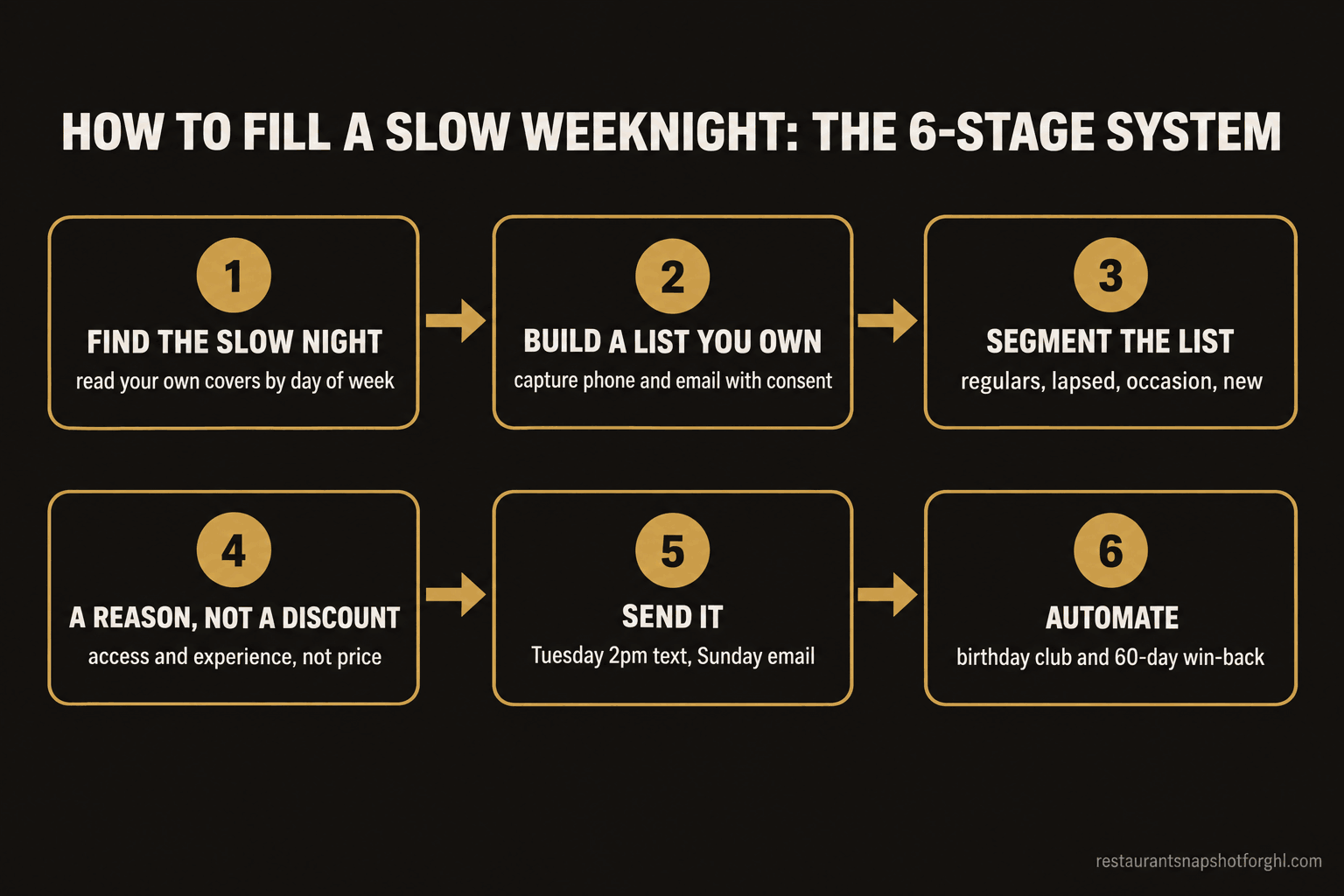
The system has six stages, below. Here is each, including how it breaks.
Stage 1: Find Which Night Is Actually Slow
Before you fix the slow night, be sure which night it is and why, because most operators run on a gut feeling that is a year out of date.
Pull your covers by day of week for the last twelve weeks. Covers, not revenue, because a few big-ticket tables hide an empty room. Monday and Tuesday trade places constantly. Then split each slow night into early and late, since a dead 5-to-6:30 with a decent 8pm is a different problem from a room that never fills. Now name the cause, because it decides the cure: offices emptied by remote work, a competitor with a good midweek event, or plain habit where nobody thinks of Tuesday as a going-out night.
How it breaks: operators promote the whole night when only the 5-to-6:30 window is dead, and end up discounting 8pm covers they already had. Measure first. See also why regulars quietly stop coming in.
Stage 2: Build a Guest List You Own
The uncomfortable truth under every slow-night problem: you cannot invite people you cannot reach. If your guest relationships live inside OpenTable, a delivery app, or Instagram’s algorithm, you do not have a list. You have access a third party can throttle, price up, or switch off.
A list you own is a phone and email list, collected with consent, that you can message any Tuesday for free. Building it is the highest-return move, because winning a new customer costs 5 to 25 times more than keeping one, and a 5 percent lift in retention can raise profits 25 to 95 percent (Harvard Business Review, 2014). Capture at every point a guest touches you: a table-tent QR code, the receipt-by-text ask, the Wi-Fi splash page, online orders. We go deep in how to own your guest list instead of renting it and restaurant QR code marketing.
How it breaks: you collect numbers with no consent language, which makes them legally unusable, or you ignore the list for six months and the first text reads like spam.
Stage 3: Segment So the Right Guest Gets the Right Nudge
A list is not a megaphone. Text everyone the same thing and you burn it, because the message that fills a Tuesday for a lapsed regular is wrong for someone who was in on Saturday.
Start with four buckets your point-of-sale or CRM data can build. Regulars, who you gently shift to a slow night, not reward for a visit they would have made anyway. Lapsed guests, gone sixty or ninety days, who need a reason to return. Occasion guests, who came once for a birthday and respond to being remembered. And new contacts, who need a welcome before they forget you. The play differs for each, and treating them as one audience is how you discount your best customers while ignoring the ones who need a push.
How it breaks: no segmentation, so every message goes to everybody, response rates crater, and opt-outs climb. The fix is boring and it works: tag guests as they come in and write to the bucket, not the crowd. Our restaurant SMS marketing playbook covers the tags in detail.
Stage 4: Design a Weeknight Reason That Is Not a Discount
The guest needs a reason to pick Tuesday over Thursday that is worth leaving the house for without being worth less money to you. Value, not price. The levers that work:
- Access. A chef’s counter night, a five-course tasting, a long table with the kitchen talking through each dish. Scarcity and experience, not a markdown. People cross town for a seat they cannot get on a weekend.
- A theme with a story. A regional-menu night, a winemaker in the room, a collaboration with a local bakery. It photographs and gives a regular a reason to bring a friend.
- A club or standing ritual. Industry Tuesday, a supper club, a members-only seating. Belonging fills a room more reliably than ten percent off, and it repeats.
- Bundled value, not cut price. A welcome glass of cava with any entree costs a dollar in pour and reads as a gift. “Twenty percent off” costs twenty percent of the ticket and reads as a sale.
The test for any offer: would a guest already coming Saturday be annoyed to learn they could have had this cheaper on Tuesday? If yes, it is a discount in disguise. For specials that pass, see our weekly specials blast that actually fills tables.
How it breaks: the offer is a discount wearing a costume, so your Saturday crowd migrates and overall revenue falls. If a server cannot pitch it while dropping menus, cut it down.
Stage 5: The Channel, the Timing, and the Copy to Steal
A great weeknight reason that nobody sees does nothing. This is where the owned list pays off: you put a message in a guest’s hand on the afternoon of the slow night, which no social post can reliably do.
Two channels carry the weight: text for the time-sensitive same-week nudge, email for the richer story and longer lead time. On reach they are not close. SMS vendors report open or delivery rates near 98 percent, though that is best read as a delivery estimate since texts have no open tracking (Infobip, 2026), against a restaurant email open rate around 31 percent (Klaviyo, 2026).
Timing matters as much as copy. Send the text early Tuesday afternoon, while people are still deciding about dinner, and the email on Sunday. Keep it to a couple of messages a week, or you train people to mute you.
None of those say “20 percent off.” They offer access, a welcome, a remembered occasion, each with a required opt-out. Our restaurant email marketing playbook covers these sequences in depth.
How it breaks: operators send one heroic blast to the whole list, so the identical text lands wrong for two of the three segments. Send to the segment, not the crowd.
Stage 6: Birthday Club and Win-Backs on Autopilot
Two automations do most of the work, both leaning on retention rather than discounting.
The birthday club is the quietest winner. You collect a birth month at signup, and the system automatically invites each guest to celebrate on a slow night during their birthday month. Birthdays are non-negotiable occasions, people bring a table, and “dessert on the house” costs a few dollars against a full party’s check. We broke down the mechanics in why a birthday club fills your slow Tuesdays.
The win-back trigger is the second engine. The system watches for a regular who has gone quiet, say sixty days without a visit, and fires a genuine “we miss you” with a reason to return on a weeknight. This is where loyalty economics show up: enrolled loyalty members visit and spend 18 to 30 percent more than non-members (Paytronix, 2021). The full approach lives in our 60-day silent-trigger win-back playbook.
Operators are already moving this way: 26 percent now use AI-related tools, and marketing is the most common use, with 19 percent of full-service operators using it for this outreach (Restaurant Dive, 2026). It needs to be automated, because a birthday club you send by hand is one you will forget. Our CRM and workflow automations and SMS automation are built for this.
How it breaks: nobody keeps the data clean, so birthdays go missing and the win-back fires at people who were in last night. Keep capture consistent and the engines run themselves.
Three Restaurants, Three Different Plans
The framework is the same. What you do with it depends on your size and staff.
The solo spot (one location, owner runs everything). You have no marketing time, so lean on automation. Build the list at the table with a QR code, turn on the birthday club and the 60-day win-back, and run one standing Tuesday event. Start with the birthday club, which returns the most for the least effort.
The growing group (two or three locations, a part-time marketer). Segmentation earns its keep. Keep one shared guest list so a regular at one venue is known at the other, tag by home location, and run location-specific events. Owning the list across venues is the asset here.
The established operator (four or more locations). You are running a program, not a promotion: a shared loyalty layer, continuous automations, and events tested at one venue before rolling out. Your discipline is measurement, because at this scale the enemy is a Tuesday that looks full while quietly stealing from the weekend. For custom builds, see GoHighLevel development for restaurants.
The Compliance Line You Cannot Skip
Everything in Stages 5 and 6 depends on texting guests, and texting guests is regulated. Two rules govern it. The TCPA requires clear prior consent before marketing texts and an easy opt-out in every message (FCC, 2026). A2P 10DLC is the carrier registration that lets your business number send these texts at all; skip it and messages get filtered before a guest sees them. The classic violation feels harmless: a host collects numbers “for the reservation” and the restaurant later texts a promo. That consent does not cover marketing.
This is not legal advice, so read the full breakdown in our TCPA and A2P 10DLC guide for restaurants and talk to your own counsel.
Objections, Answered Straight
“My regulars will be annoyed by a marketing text.” They will be annoyed by a bad one. A generic blast every day earns an opt-out; a single, relevant, well-timed invite to something they would enjoy, with a real opt-out, does not.
“I already pay OpenTable. Isn’t that my marketing?” It fills your book, but the guest list largely belongs to them, and reaching those diners on a slow Tuesday is expensive or impossible. A list you own does the one thing platforms will not do for free: let you message your own guests on demand.
“I’m not technical. This sounds like a lot of software.” The capture is a QR code and a form. The segmenting, birthday club, and win-backs run on automations you set up once; you greet guests while the system sends. If setup is the scary part, that is the part worth having done for you.
“Won’t a weeknight event just steal from my weekend?” It can, if the event is a discount in disguise, which is why Stage 4 has the cannibalization test. An exclusive counter night pulls people who were not coming that week at all; a blanket price cut just pulls your Saturday crowd forward. Build the former and measure both nights.
Frequently Asked Questions
Filling slow restaurant weeknights: quick answers
How do I fill a slow Tuesday without discounting?
Give existing guests a time-boxed reason that adds value instead of cutting price, like a chef's counter night or a birthday celebration, and invite them through a text and email list you own. See our weekly specials playbook.
Why is discounting a slow night a bad idea?
Full-service restaurants run net margins of about 3 to 5 percent, so a 20-percent-off night can wipe out the whole night's profit even when the room is full, and it teaches weekend regulars to shift to the cheaper night. See Toast's margin data.
What offer works better than a discount for a weeknight?
Access and experience beat price: a limited chef's counter dinner, a themed night, or a bundled gift like a welcome glass with any entree. The test is whether a Saturday regular would be annoyed to learn they could get it cheaper on Tuesday. If yes, it is a discount in disguise.
Is text or email better for filling a slow night?
Use both. Text is the same-week nudge because it gets seen fast; SMS vendors report delivery estimates near 98 percent, though that is not a measured open rate. Email, around 31 percent open rate per Klaviyo, carries the richer story. A Sunday email sets up the week; a Tuesday-afternoon text closes it.
Do I need consent to text my restaurant guests?
Yes. The TCPA requires clear prior consent before marketing texts and an easy opt-out in every message, and you need A2P 10DLC registration to send at all. A number collected for a reservation does not count. Read our TCPA and A2P 10DLC guide and check with your own counsel.
The Bottom Line
Back to that 4:30 Tuesday walk through an empty room. The coupon was never going to fix it, because a dead Tuesday is a demand problem wearing a price-tag costume. Build the list, segment it, give guests a reason that adds value instead of cutting price, and reach them through a channel you own at the hour it matters. Then let the birthday club and win-backs carry the slow night on their own, and the full Tuesday finally makes money while your Saturday stays exactly as profitable as it was.