
There’s a moment most growing restaurant operators hit with GoHighLevel. The stock setup — the snapshot you deployed in a day — is quietly running your reminders, your review asks, your win-backs, and it’s working. Then you try to do one specific thing: sync Toast loyalty check-ins so a guest who’s spent $500 this month drops into a VIP pipeline automatically. Or pull Resy cancellations in real time to fire a no-show sequence. Or give your five locations one branded guest portal. And you find the wall — GHL doesn’t ship it, no marketplace plugin fits, and you’re back to copy-pasting between tabs.
That wall is where custom GoHighLevel development starts paying for itself. This is the plain-English guide to it for U.S. restaurant operators and the agencies that serve them: what custom GHL development actually is, the signs you’ve outgrown off-the-shelf, what gets built, and how to think about the return — with current 2026 data, not hand-waving.
Table of Contents
- The 30-second answer
- What is custom GoHighLevel development?
- Why 2026 is the year restaurants are building on GHL
- 5 signs you’ve outgrown off-the-shelf GHL
- What custom GHL development actually builds
- Stock snapshot vs custom development: which do you need?
- The ROI: what custom development is worth
- How a custom GHL engagement works
- Frequently asked questions
The 30-Second Answer
Custom GoHighLevel development is the work of building software, AI agents, and integrations on top of GoHighLevel that the platform doesn’t do on its own — so your restaurant’s tools, data, and follow-up all run as one system. For most restaurants, a done-for-you snapshot covers the essentials: reminders, reviews, missed-call text-back, win-backs. You reach for custom development when you need a specific thing off-the-shelf can’t give you — a Toast or Resy connector, a branded loyalty dashboard, a menu-aware AI agent, a reporting view across five locations, or a clean move off a legacy platform.
The tell is simple: if your team is re-keying guest data by hand, or you keep saying “I wish GHL could just…,” you’ve hit the ceiling of the stock setup. That’s the line where a fixed-scope custom GHL build starts returning more than it costs — because the value in a restaurant CRM isn’t the features, it’s whether they’re connected.
What Is Custom GoHighLevel Development?
GoHighLevel is a genuinely powerful CRM and marketing engine — it’s the reason a snapshot can run your reservations, reviews, and repeat-visit texts out of the box. But it was never built to run a kitchen, a floor, or a delivery operation, and it doesn’t natively talk to the dozen other tools a modern restaurant runs on.
Custom GoHighLevel development fills those gaps. In practice it’s four distinct kinds of work:
- Custom software on top of GHL — guest portals, loyalty dashboards, private-event pipelines, operator reporting views: features GHL doesn’t ship, built on your GHL data and branded to your restaurant.
- Custom AI agents — an AI reservation host, a no-show recovery caller, a review responder, or a menu-aware chatbot trained on your concept, not a generic bot, and wired straight into your GHL sub-account.
- Integrations that connect any platform to GHL — Toast, Square, Clover, OpenTable, Resy, SevenRooms, 7shifts, DoorDash, UberEats, Stripe: real-time, two-way sync so your guest data lives in one place instead of eight.
- Full migration to GHL — moving contacts, tags, pipelines, history, and workflows off a legacy CRM or website builder without losing a thing, then rebuilding the automations better.
It’s not a POS, a reservation provider, or a delivery app — it sits in front of and between the tools you already run. If you’re still deciding whether GHL is right for your restaurant at all, start with our complete guide to GoHighLevel for restaurants; this piece is about what happens after the stock setup stops being enough.
Why 2026 Is the Year Restaurants Are Building on GHL
Two things are true at once in 2026: restaurants are investing in technology harder than ever, and most of that technology still doesn’t connect. That gap is exactly what custom development closes.
Start with the spend. In the National Restaurant Association’s 2026 State of the Restaurant Industry report, 60% of operators say they plan to increase their technology investment in the year ahead, and 26% already use AI in some form — with marketing the single most common use (19% of full-service and 15% of limited-service operators use AI to help with it) (National Restaurant Association, 2026, via Restaurant Dive).
How U.S. restaurant operators are approaching technology in 2026 (% of operators). Source: National Restaurant Association, 2026 State of the Restaurant Industry, via Restaurant Dive.
Now the platform they’re building on. GoHighLevel has become core infrastructure for small-business marketing: it reports powering more than 60,000 agencies and over 1.4 million business sub-accounts as of late 2025, with its footprint roughly doubling from 2023 to 2025 (GoHighLevel, 2025). That maturity matters — it means the API surface, the webhook system, and the AI tooling are stable enough to build production restaurant software on, not a science experiment.
The operators pulling ahead aren’t the ones buying more tools. They’re the ones connecting the tools they already have into automated follow-up — and increasingly, that connective work is a custom build on top of GHL.
5 Signs You’ve Outgrown Off-the-Shelf GHL
A stock snapshot is the right starting point for almost every restaurant. But there are clear, concrete signals that you’ve hit its ceiling and a custom build will pay off. If two or more of these sound like your week, it’s time.
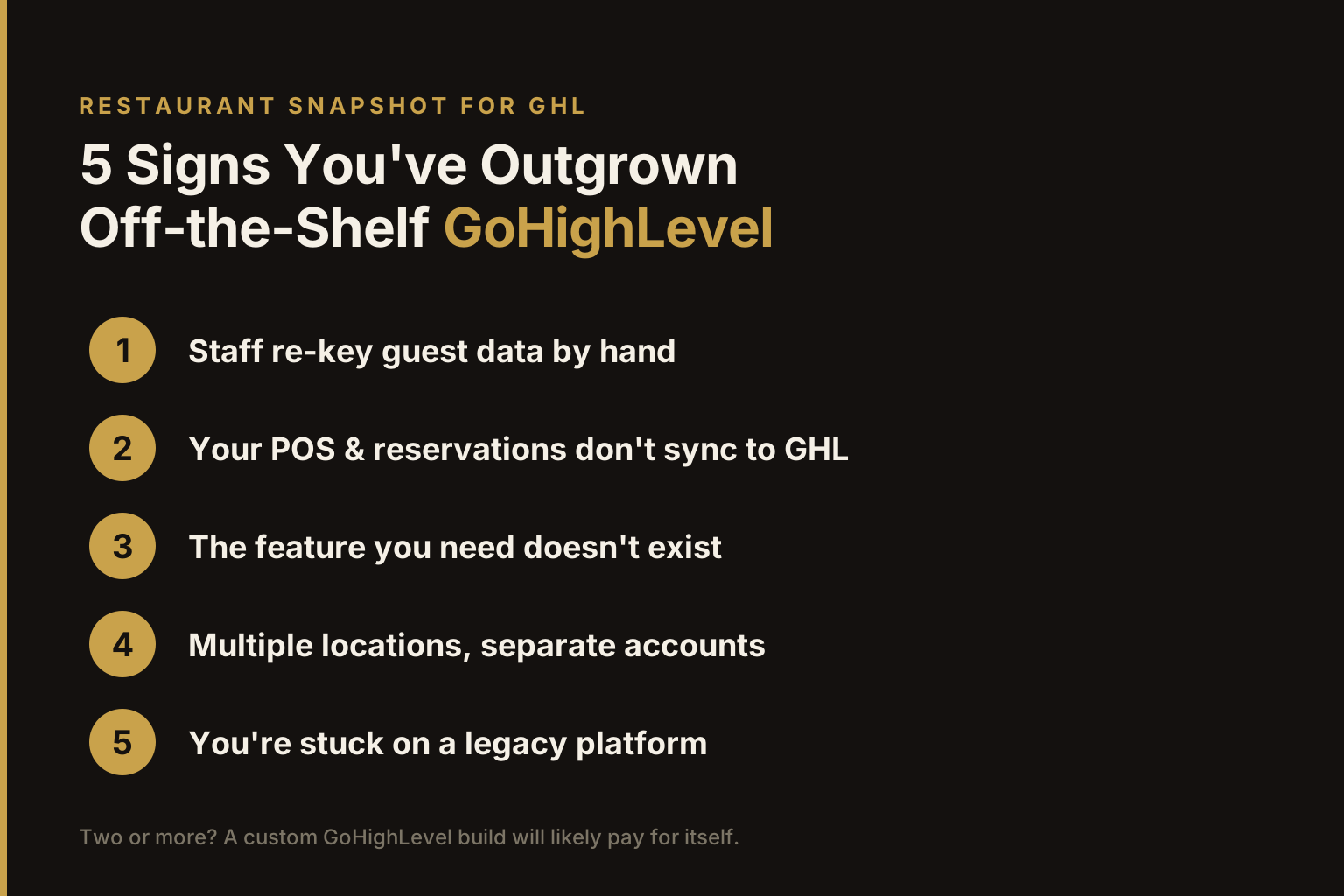
- Your team re-keys guest data by hand. A reservation lands on Resy, gets copied to a spreadsheet, then typed into GHL for the follow-up text. Multiply that across every channel and every shift and it’s hours of labor — and guests who slip through when someone forgets a step.
- Your POS and reservations don’t talk to GHL. Toast, Square, and Clover hold your sales; OpenTable and Resy hold your covers. If none of it flows into GHL automatically, you can’t trigger spend-based VIP win-backs or real-time no-show recovery — the automations that actually move revenue.
- The feature you need simply doesn’t exist. A branded loyalty dashboard, a private-events pipeline, a POS-triggered win-back, an operator report that blends covers and no-show rate by shift — GHL doesn’t ship it and no plugin fits your concept. It has to be built.
- You’re running multiple locations from disconnected accounts. Two to fifty venues, each with its own login, its own reports, and no single guest view. Multi-unit operators need a consolidated layer that off-the-shelf GHL doesn’t provide out of the box — the same reason many groups eventually hire a dedicated GHL operator or dev team.
- You’re stuck on a legacy platform. Your contacts, pipelines, and history are trapped in a CRM or website builder you’ve outgrown, and moving feels risky — so you keep paying for a tool that doesn’t fit. A proper migration removes that risk.
Notice the theme: none of these are “GHL is bad.” They’re all “GHL, as shipped, stops one step short of what my restaurant needs.” That one step is the job. For a deeper look at what a fragmented, disconnected stack quietly costs before you fix it, see our breakdown of the hidden cost of a disconnected restaurant tech stack.
What Custom GHL Development Actually Builds
“Custom development” sounds abstract until you see the concrete builds. Here’s what restaurant operators and food-service agencies most commonly commission on top of GoHighLevel.
- POS ↔ GHL integration. A connector that syncs Toast, Square, or Clover sales and loyalty check-ins into GHL as tagged, segmented guest records — so a guest crossing a spend threshold drops into a VIP pipeline automatically, both directions, in real time.
- Reservation platform bridge. OpenTable, Resy, or SevenRooms covers and cancellations flowing into GHL the moment they happen, firing confirmations, reminders, no-show recovery, and post-visit review asks. (Pair it with a proper online reservation flow and the loop closes itself.)
- Menu-aware AI chatbot and voice agents. A website or phone agent that actually knows your menu, hours, and allergy policy — qualifies private events, books tables into GHL, and logs every contact. It’s the custom cousin of the off-the-shelf AI caller and AI phone answering most restaurants start with.
- Guest & operator dashboards. A branded loyalty/guest portal where regulars view reservations and unlock offers, plus a live operator report pulling GHL + POS + reservation data: covers by shift, no-show rate by day, repeat-visit rate by channel — the numbers that actually drive decisions.
- GHL Marketplace apps. For agencies: a restaurant-niche app you can white-label and resell across dozens of sub-accounts — a real product, not a one-off.
- Full migration. Contacts, tags, pipelines, and years of history moved onto GHL intact, with every reservation and review workflow rebuilt on the other side.
Where a build spans beyond GHL entirely — a standalone guest app, a franchise portal, agentic AI that lives outside the CRM — that’s the territory of full custom software development. The two services overlap: start on GHL, extend past it only when the job genuinely requires it.
Stock Snapshot vs Custom Development: Which Do You Need?
This isn’t an either/or — it’s a sequence. Almost every restaurant should start with the stock snapshot; a smaller set graduates to custom development when they hit the ceiling above. Here’s the honest scorecard.
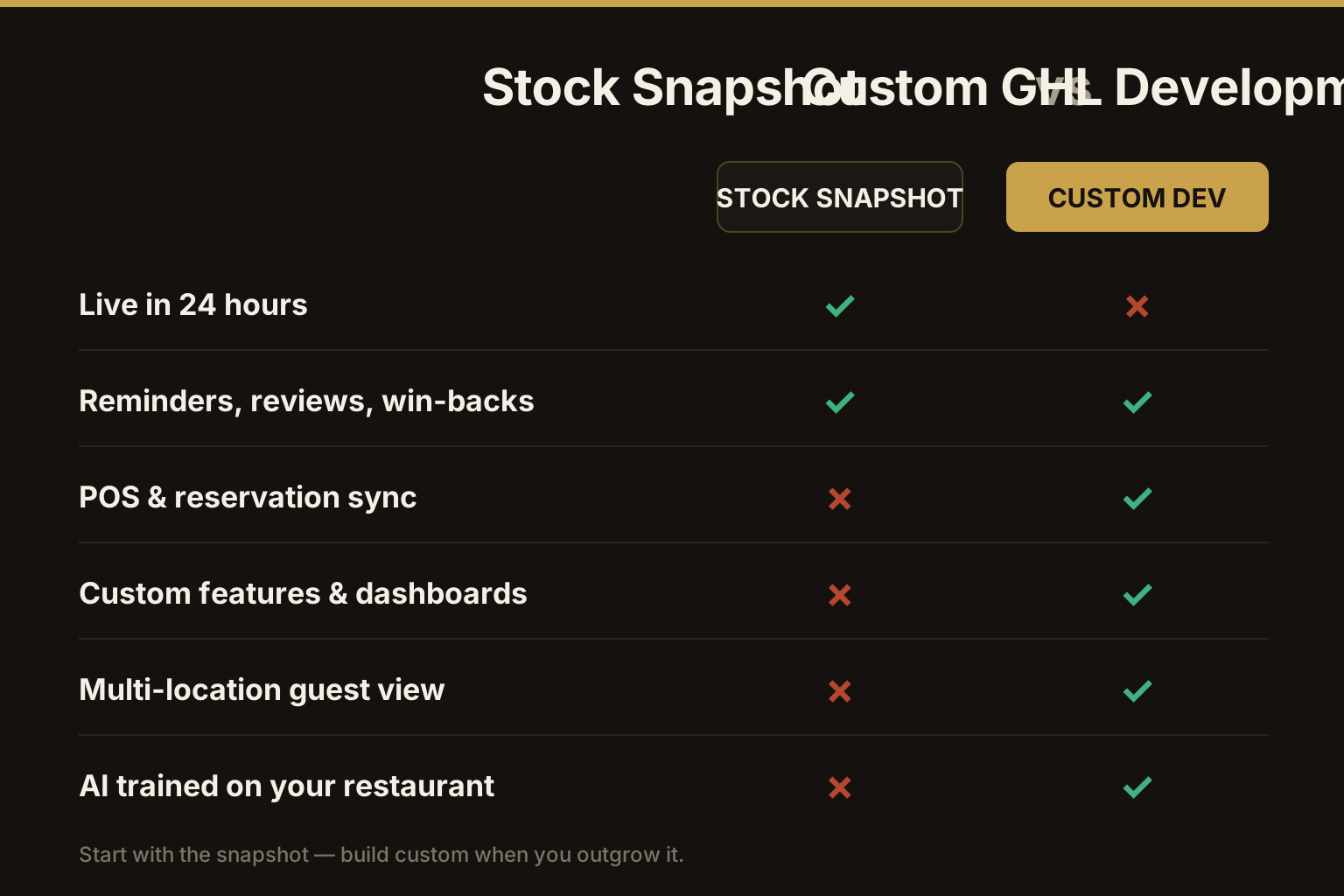
Stock snapshot vs custom GoHighLevel development
| Plan | Stock Snapshot recommended | Custom GHL Development |
|---|---|---|
| Price | $997 · live in 24h | From ~$3K / project |
| Feature 1 | Reminders, reviews, missed-call text-back, win-backs out of the box | Everything the snapshot does, plus what it can't |
| Feature 2 | Standard reservation + review + SMS workflows, prebuilt | Bespoke workflows and dashboards built to your operation |
| Feature 3 | No custom POS or reservation-platform sync | Two-way Toast / Square / Resy / OpenTable sync in real time |
| Feature 4 | Uses GHL's built-in features as shipped | Features GHL doesn't ship — portals, pipelines, reports |
| Feature 5 | One account; standard multi-location setup | Consolidated multi-location guest view and reporting |
| Feature 6 | Generic AI caller / chatbot templates | AI agents trained on your menu, policies, and tone |
| Feature 7 | Best for: getting a proven system live fast | Best for: scaling operators & agencies past the ceiling |
The rule of thumb: buy the snapshot first, build custom second. Prove the fundamentals with the done-for-you package, then invest in custom development only where you have a specific, revenue-linked gap the stock setup can’t reach. That order keeps your spend disciplined and your ROI clear.
The ROI: What Custom Development Is Worth
Custom work isn’t cheap — fixed-price restaurant builds typically start around $3K for a focused integration and scale with complexity. So the only question that matters is whether it returns more than it costs. For most restaurants, the math comes down to two things: guest data you own, and repeat visits you automate.
Start with what you’re losing to third parties. Delivery apps charge 15% to 30% commission per order — DoorDash’s tiers run 15% (Basic), 25% (Plus), and 30% (Premier) — and once processing and promotions are layered on, the effective cost commonly lands at 30% or more (Sauce, 2026). Worse than the fee: the platform keeps the guest’s name, email, and phone number. You cooked the food and never met the customer.
Third-party delivery commission by plan tier (% of order total, DoorDash). Source: Sauce, 2026. Effective cost often reaches 30%+ after processing and promotions.
A custom integration that pulls first-party order data into GHL turns those anonymous delivery orders into contacts you can re-market to directly — off the third-party platform, at your margin, not theirs. That’s the difference between renting a customer and owning one.
Then there’s the bigger prize: repeat visits. Returning guests drive roughly 60% of restaurant revenue — 64% at full-service and 71% at quick-service — and a repeat guest generates about 26× more revenue over their lifetime than a one-time visitor (Olo via Restroworks, 2024). Yet around 70% of first-time diners never come back. The whole point of a connected GHL system — POS spend flowing in, reservations triggering follow-up, birthdays and win-backs firing on their own — is to move guests from that 70% into the 60%.
Put it against a 3–5% net margin (Toast, 2026) and the case writes itself: on thin margins, a repeat cover you recovered automatically — or a delivery guest you brought back in-house — is worth many times a dollar of new top-line revenue you had to fight and spend to win. A one-time custom build that makes that follow-up automatic and permanent is one of the highest-leverage investments a growing restaurant can make. For the full math on this, see our guide to restaurant customer lifetime value.
How a Custom GHL Engagement Works
The word “custom” scares operators who’ve been burned by open-ended dev projects. A good restaurant GHL engagement is the opposite of open-ended — it’s fixed-scope and predictable:
- Discovery call (free). 30 minutes to understand your GHL setup, your stack, and the exact integration or feature you need.
- Fixed written quote. A scope with milestones, deliverables, a timeline, and a fixed price before anything starts. No moving targets.
- Build sprints. One-to-four-week sprints with weekly demos, so you watch real GHL data flow through real code as it’s built — a POS connector in about 2–4 weeks, a reservation bridge in 2–3, a migration in 2–5 depending on data volume.
- Testing against your real account, then deploy. Edge cases, security, and performance tested against your actual GHL sub-account — then deployed to your infrastructure with a bug-fix warranty and full ownership of the code.
If you’d rather have ongoing hands on your GHL than a one-off build, that’s a different service — a dedicated GHL VA or elite operator who runs the system day to day. Many multi-unit groups end up with both: a dev team for the builds, an operator for the daily run. The Miami operators we profiled in why restaurants hire a GoHighLevel VA went exactly that route.
The Bottom Line
A stock GoHighLevel snapshot is the right first move for almost every restaurant — it gets a proven system live in a day and starts filling tables immediately. Custom GoHighLevel development is what you reach for when you’ve outgrown it: when your POS won’t sync, when the feature you need doesn’t exist, when five locations need one view, or when you’re stuck on a platform you’ve outgrown. In a year when 60% of operators are increasing their tech spend and repeat guests already drive 60% of revenue, the operators who win won’t be the ones with the most tools — they’ll be the ones whose tools finally work as one system. That’s the job custom development does.
Frequently Asked Questions
Custom GoHighLevel development for restaurants — common questions
What is custom GoHighLevel development for a restaurant?
It's the work of building software, AI agents, and integrations on top of GoHighLevel that the platform doesn't do on its own. In practice it's four things: custom software GHL doesn't ship (guest portals, loyalty dashboards, operator reports), custom AI agents trained on your restaurant, integrations that sync your POS and reservation tools to GHL, and a clean migration onto GHL. It sits in front of the tools you already run — it is not a POS, reservation, or delivery platform.
How do I know if I've outgrown the stock snapshot?
The clearest signals: your staff re-key guest data by hand between systems; your POS (Toast, Square, Clover) and reservations (OpenTable, Resy) don't sync to GHL; the feature you need doesn't exist and no plugin fits; you're running multiple locations from disconnected accounts with no single guest view; or you're stuck on a legacy platform. If two or more of those describe your week, a custom build will likely pay for itself.
Can you connect Toast, Square, Resy, or OpenTable to GoHighLevel?
Yes — that's one of the most common restaurant builds. A custom connector syncs POS sales and loyalty check-ins, or reservation covers and cancellations, into GHL in real time and both directions, so spend thresholds trigger VIP win-backs and cancellations trigger no-show recovery automatically. If a platform has an API, a webhook, or an export, it can be wired to GoHighLevel.
How much does custom GoHighLevel development cost?
Fixed-price restaurant builds typically start around $3K for a focused integration, rising with complexity for AI agents, reservation bridges, guest dashboards, and marketplace apps. Migrations are quoted by data volume, and hourly retainers are available for evolving scope. Every project is scoped with a written, fixed quote and timeline before work begins, so there are no surprises. Book a discovery call for a real number on your specific build.
Is custom development worth it on a restaurant's thin margins?
That's exactly why it can be. Full-service restaurants net just 3–5%, so recovering a repeat cover automatically or bringing a delivery guest back in-house is worth many times a dollar of hard-won new revenue. Repeat guests already drive about 60% of restaurant revenue and generate roughly 26× more than one-time visitors, and third-party delivery apps take 15–30% per order while keeping the customer's data. A one-time build that automates repeat visits and brings guest data in-house targets both of those directly.
Do I own the code, and how long does a build take?
You should own 100% of the code — insist on full IP transfer, deployed to your own infrastructure. Timelines are predictable: a POS-to-GHL connector runs about 2–4 weeks, a reservation bridge 2–3 weeks, and a full migration 2–5 weeks depending on data volume, all scoped with a fixed timeline before the first sprint.
Marisol spent nine years running front-of-house and marketing for a three-location Tex-Mex group before going all-in on automation. She now designs GoHighLevel snapshots and multi-unit rollouts for independent restaurants and small groups, with a soft spot for POS-to-CRM integrations and AI booking flows that fill slow weeknights. She writes the way she ran her floor: practical, fast, and allergic to fluff.
Related reading
- The hidden cost of a disconnected restaurant tech stack
- GoHighLevel for restaurants: the complete 2026 guide
- Why restaurants hire a GoHighLevel VA to run their marketing
- Restaurant customer lifetime value: how to calculate it (and double it)
- AI phone answering for restaurants: stop losing bookings to missed calls
Sources
- National Restaurant Association — 2026 State of the Restaurant Industry (26% use AI; 60% plan to increase tech investment; marketing is the #1 AI use)
- Restaurant Dive — Over 25% of restaurant operators use AI (NRA 2026 coverage)
- GoHighLevel — Platform scale: 60,000+ agencies and 1.4M+ business sub-accounts (2025)
- Sauce — DoorDash vs Uber Eats for restaurants (15–30% commission by tier, 2026)
- Rezku — Third-party delivery fees in 2026: what DoorDash, Uber Eats & Grubhub really cost
- Restroworks — Restaurant customer retention statistics (Olo: repeat guests ≈ 60% of revenue; 26× lifetime revenue; ~70% of first-timers never return)
- Toast — Average restaurant profit margin (3–5% full-service, 2026)